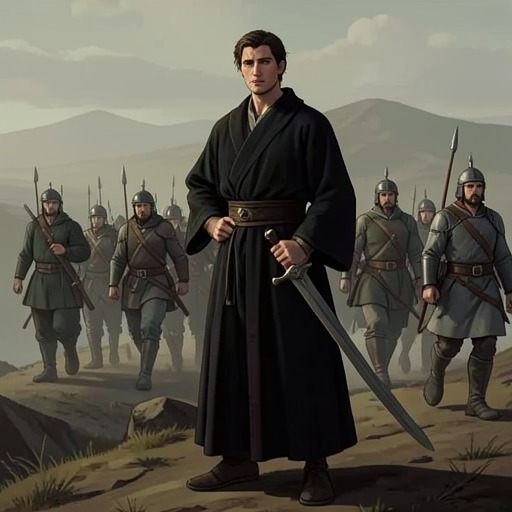
Sun Ce's Duel with Taishi Ci
The Romance of the Three KingdomsSun Ce’s duel with Taishi Ci is a defining encounter in Sun Ce’s campaign against Liu Yao: a temple-side contest that neither warrior can win, followed by a reversal in which the captured opponent becomes a trusted ally. The scene makes a personal rivalry the hinge between the armies’ conflict and their eventual realignment.
The temple encounter
Before the duel, Sun Ce dreams that the founder of the Later Han summons him to a temple dedicated to his memory. Told the temple lies south, near Liu Yao’s encampment, Sun Ce’s advisers urge him not to go. He insists on praying for success, trusting that the gods will protect him, and rides there with only twelve guards.
The risk is immediately apparent: Liu Yao’s men spot Sun Ce. Liu Yao suspects the exposure is bait for an ambush and tries to prevent his forces from engaging. Taishi Ci, eager to fight, disregards those pleas and rides out with only one other, minor commander. The encounter begins not as a planned battle between the main armies but as the consequence of Sun Ce’s solitary visit and Taishi Ci’s decision to seize the opportunity.
An unresolved test of strength
Sun Ce and Taishi Ci fight for fifty rounds without either gaining the advantage. Sun Ce has twelve guards, while Taishi Ci is accompanied by just one man. Taishi Ci feigns retreat and draws Sun Ce away from his guards; when he turns back, their contest resumes with greater desperation. Both are eventually knocked from their horses, but continue fighting on the ground until soldiers from each side arrive and separate them.
The duel settles no military outcome. Instead, its unresolved finish gives the two commanders a measure of one another before their armies’ wider encounters. The narrative describes the ensuing feud as shaping the battles across the countryside, where both sides use subterfuge. Taishi Ci is eventually captured and brought before Sun Ce.
From adversaries to allies
Sun Ce greets his prisoner as a true hero. Their exchange returns to the temple fight: Sun Ce asks whether Taishi Ci would have killed him had he captured him there. Taishi Ci answers that he does not know. Sun Ce laughs and invites him to dine with him; moved by Sun Ce’s treatment, Taishi Ci offers to bring over Liu Yao’s divided and dispirited troops if Sun Ce will trust him.
Sun Ce does trust him. Taishi Ci recruits thousands of Liu Yao’s soldiers to join Sun Ce, turning the earlier personal contest into a consequential change of allegiance. The passage thus links martial recognition with political and military gain: the duel does not produce a victor, but the respect established between its participants helps Sun Ce enlarge his forces.
Narrative significance
The episode’s movement is from apparent vulnerability to unexpected advantage. Sun Ce approaches a temple with a small escort because he believes divine protection will attend his prayer; that choice exposes him to the enemy, but the resulting duel becomes the first defining encounter in a relationship that later benefits his campaign. Taishi Ci’s defiance of Liu Yao’s caution first makes him Sun Ce’s opponent; after capture, his offer and recruitment make him an ally.
More broadly, the novel’s account sits within a work built on historical events reshaped by oral storytelling, theatre, poetry, and a novelist’s composition. Its introduction distinguishes that historical foundation from the dramatic retelling through which figures become heroes, rivals, and betrayers. The temple duel’s sharply staged encounter and subsequent reversal illustrate how a conflict between armies can be rendered memorable through a personal contest, then carried forward through its consequences.